
ASME vs DOT Propane Tanks
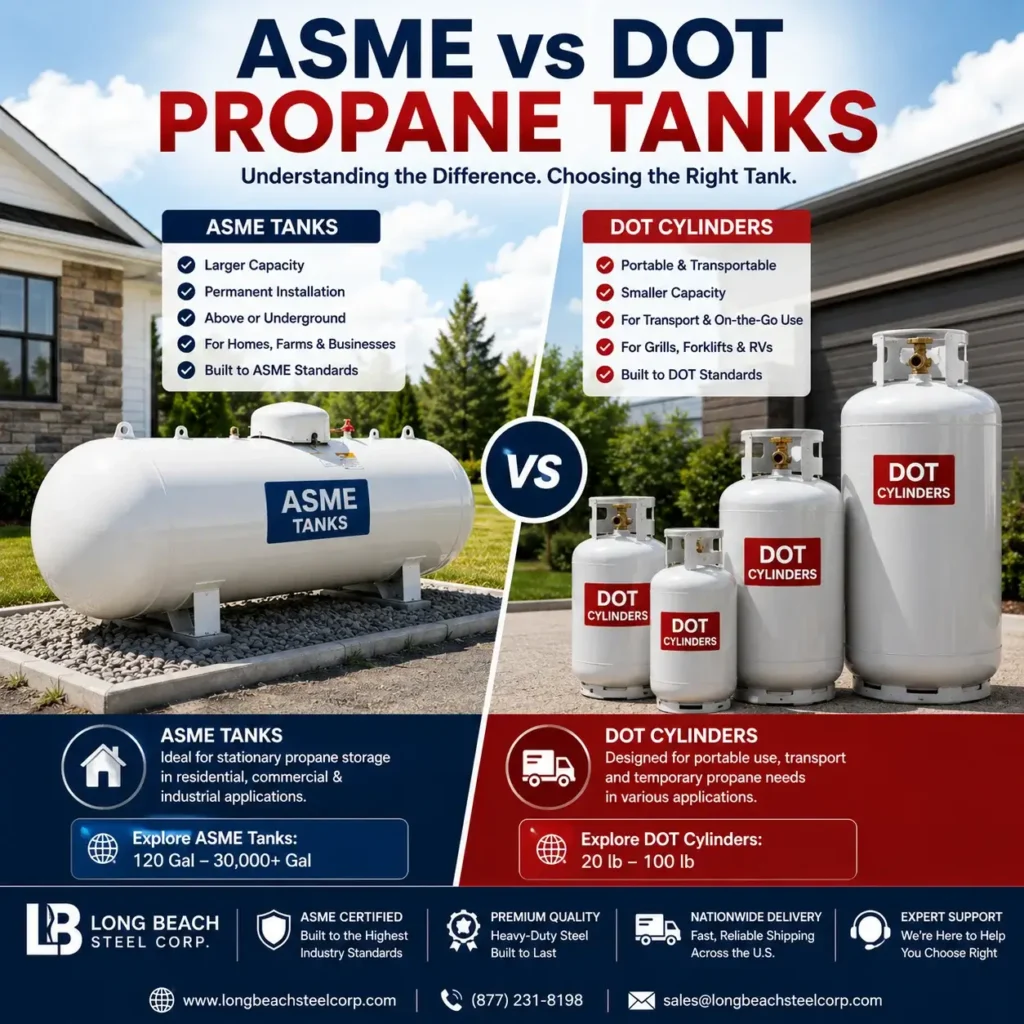
Understanding ASME vs DOT propane tanks is important when choosing propane storage equipment for a home, farm, commercial property or industrial facility. Although both ASME tanks and DOT cylinders are used to store propane, they are designed for different applications and are subject to different standards and requirements.
The right container depends on how propane will be used, whether the equipment will remain stationary or be transported, the required storage capacity and the installation conditions. Choosing the correct type of propane container can help ensure that your equipment is appropriate for its intended service.
What Are ASME Propane Tanks?
ASME propane tanks are pressure vessels manufactured according to applicable American Society of Mechanical Engineers requirements. They are commonly used as stationary propane storage tanks for residential, agricultural, commercial and industrial applications.
ASME propane tanks are available in many capacities. Long Beach Steel Corp offers options ranging from smaller stationary tanks to large-capacity storage equipment, including 120 gallon ASME propane tanks, 250 gallon ASME propane tanks and 500 gallon ASME propane tanks.
Larger properties and commercial facilities may require greater storage capacity. Options can include 1000 gallon ASME propane tanks, 2000 gallon ASME propane tanks and larger LPG storage systems.
What Are DOT Propane Cylinders?
DOT propane cylinders are containers manufactured and approved according to applicable U.S. Department of Transportation requirements for portable cylinders and transportation service. They are commonly used where propane needs to be stored in a portable container.
Examples include cylinders used with compatible grills, heaters, recreational equipment and other portable propane appliances. Specialized cylinders are also available for equipment such as forklifts.
Long Beach Steel Corp offers a 20 lb propane cylinder for suitable portable applications and a 33.5 lb forklift propane cylinder for compatible propane-powered material-handling equipment.
ASME vs DOT Propane Tanks: The Main Difference
The most important difference between ASME and DOT propane containers is their intended use.
ASME tanks are generally associated with stationary propane storage systems. They are available in larger capacities and are commonly installed at homes, farms, commercial properties and industrial facilities.
DOT cylinders are generally associated with portable propane storage and transportation. They are designed with requirements that address their use as transportable cylinders.
Because their designs and intended services differ, an ASME tank should not simply be substituted for a DOT cylinder or vice versa. Always verify that the container is approved for the specific application.
ASME Propane Tanks for Stationary Storage
ASME tanks are often selected when propane needs to remain stored at a fixed property or facility.
Residential Applications
Homes may use stationary ASME tanks for propane heating, cooking, water heating, clothes drying, fireplaces and backup generators.
The required capacity depends on the home’s fuel consumption and the number of propane appliances. A smaller property may need a smaller stationary tank, while a larger home with multiple propane systems may require a 500 gallon or 1,000 gallon tank.
Agricultural Applications
Farms and agricultural operations can use propane for crop drying, livestock facilities, heating, workshops and other equipment. Fuel demand can vary significantly depending on the season and the operation.
Stationary ASME storage can provide a larger fuel reserve for agricultural properties that require regular propane deliveries.
Commercial and Industrial Applications
Businesses and industrial facilities may use propane for heating, cooking, manufacturing processes, forklifts and other equipment. Larger operations may require multiple tanks or high-capacity LPG storage systems.
For substantial storage requirements, buyers may need to consider equipment such as a 5000 gallon LPG storage tank or larger industrial storage equipment.
DOT Propane Cylinders for Portable Applications
DOT cylinders are particularly useful when propane needs to be transported or used with portable equipment.
20 lb Propane Cylinders
A 20 lb propane cylinder is a common portable propane storage option. It can be suitable for compatible outdoor cooking equipment, recreational appliances, heaters and other applications where a relatively small propane supply is required.
Its compact design makes it easier to transport than a large stationary propane tank, but its capacity is significantly lower than that of an ASME storage tank.
Forklift Propane Cylinders
Forklifts and other material-handling equipment can use specialized propane cylinders. The 33.5 lb forklift propane cylinder is designed for compatible applications where the cylinder configuration and equipment requirements match.
Forklift cylinders should not be treated as interchangeable with standard barbecue cylinders. Always confirm the correct cylinder type and connection requirements for the equipment.
Capacity Differences Between ASME and DOT Containers
One of the most obvious differences is storage capacity. DOT cylinders are generally associated with smaller portable applications, while ASME tanks can range from relatively small stationary tanks to very large commercial and industrial storage vessels.
For example, a 20 lb propane cylinder is very different from a 500 gallon stationary propane tank. The correct choice depends on the amount of fuel required and whether the equipment needs to remain stationary.
If you are comparing different capacities, read our Propane Tank Sizes: A Complete Guide for Buyers.
Installation Considerations
ASME propane tanks generally require a permanent or semi-permanent installation. The tank location, foundation, supports, piping, valves, clearances and delivery access all need to be considered.
DOT cylinders are typically used with portable equipment, but their storage and use still need to follow applicable requirements. Cylinders should be protected from damage and stored or transported according to the requirements applicable to their service.
The exact requirements depend on the container, application and location. A qualified propane professional should evaluate the proposed installation or equipment before use.
Above-Ground and Underground ASME Tanks
ASME propane tanks can be used in different installation configurations depending on their design and approval. Above-ground tanks remain visible, while approved underground tanks are installed below the surface.
Above-ground tanks can provide easier visual access for inspection and maintenance. Underground tanks can reduce the visual impact of propane storage but require additional planning for excavation, corrosion protection and future access.
Not every ASME tank is suitable for underground installation. The specific tank must be approved for the intended installation configuration.
Read our related guide, Above Ground vs Underground Propane Tanks, for a detailed comparison.
How to Choose Between ASME and DOT
Start by identifying how the propane container will be used.
Choose an ASME Tank When:
- You need stationary propane storage.
- Your property requires a larger propane supply.
- You are storing propane for a home, farm, business or industrial facility.
- You need a capacity measured in gallons rather than a small portable cylinder.
- The tank will form part of a permanent propane storage system.
Consider a DOT Cylinder When:
- You need portable propane storage.
- The cylinder will be transported as part of its intended service.
- You are supplying compatible portable appliances or equipment.
- You need a smaller propane capacity.
- You require a specialized cylinder for compatible equipment such as a forklift.
Check the Tank or Cylinder Identification
Before purchasing propane storage equipment, inspect the identification and markings on the container. The nameplate or required markings can provide important information about the equipment and its intended service.
For used equipment, buyers should pay particular attention to the container’s condition, previous service, corrosion, repairs, inspection history and available documentation.
Do not assume that a container is suitable simply because it physically connects to a piece of equipment. Compatibility and approval for the intended service are essential.
ASME and DOT Propane Safety
Both ASME tanks and DOT cylinders contain pressurized propane and must be handled appropriately. The container should be used only for its approved purpose and should not be modified without qualified professional guidance.
Installation, filling, inspection and maintenance should be performed according to applicable requirements. Keep propane containers away from unauthorized activities and potential sources of ignition, and maintain appropriate access for inspection and servicing.
For additional information about propane storage and installation requirements, consult the NFPA 58 Liquefied Petroleum Gas Code.
General propane safety information is also available from the Propane Education & Research Council.
Buying New, Used or Refurbished Propane Containers
ASME tanks and DOT cylinders can be available in new, used or refurbished condition. The condition of the specific container should always be evaluated before purchase.
Used propane equipment can be an option for projects where the container’s condition and specifications meet the intended requirements. Ask for available documentation and information about previous service and inspection.
Refurbished equipment may have undergone specific restoration or reconditioning work. Buyers should establish what work was completed and verify the equipment’s suitability for the intended application.
Long Beach Steel Corp offers used propane gas tanks and refurbished propane tanks for customers comparing different storage options.
Final Thoughts on ASME vs DOT Propane Tanks
When comparing ASME vs DOT propane tanks, the most important consideration is the intended application. ASME tanks are commonly used for stationary propane storage and are available in capacities suitable for residential, agricultural, commercial and industrial applications. DOT cylinders are generally intended for portable propane storage and transportation applications.
Before buying, consider the required capacity, intended use, installation location, equipment compatibility, container condition and applicable requirements. Choosing the correct container can help ensure that your propane storage system is appropriate for the project.
Long Beach Steel Corp offers a range of propane tanks and cylinders for different applications. Explore our propane tanks for sale to compare available options, capacities and conditions, or contact us for current specifications, pricing and availability.