

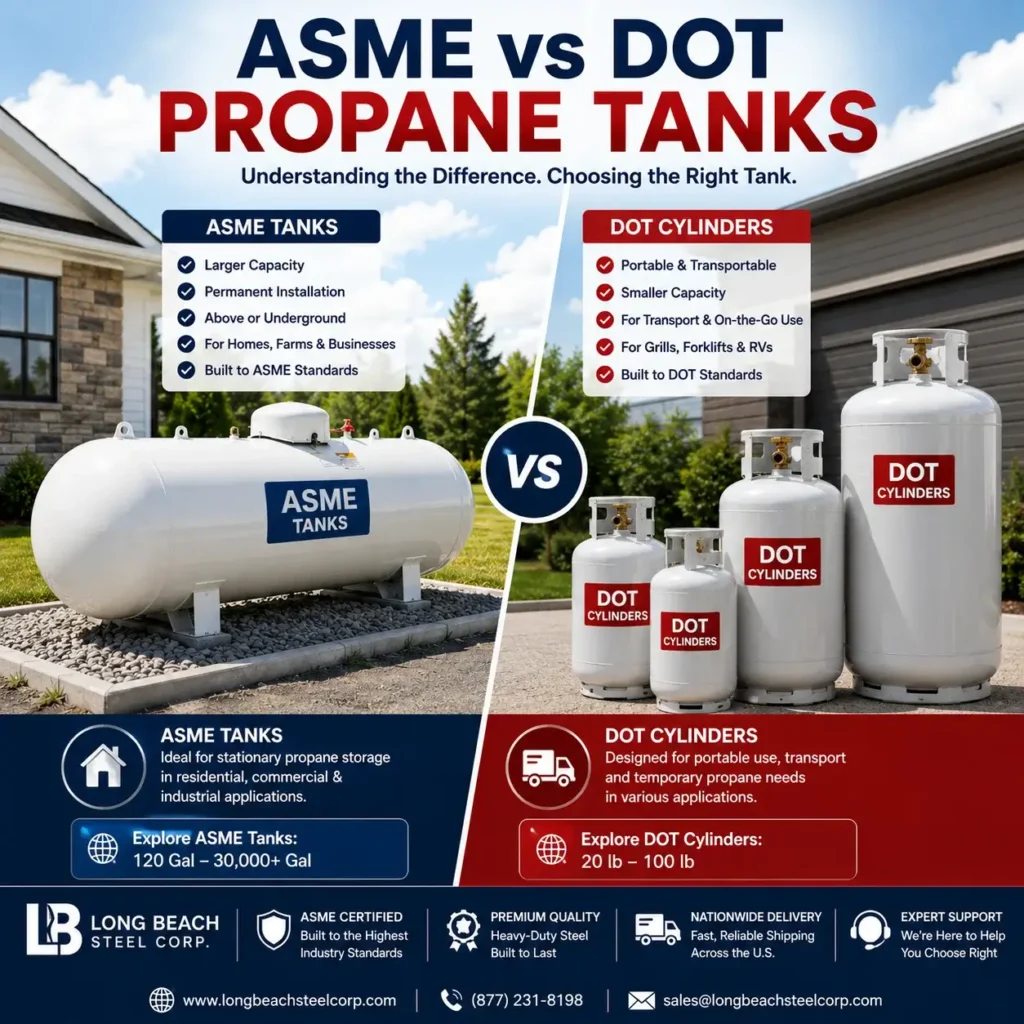
ASME vs DOT Propane Tanks
ASME vs DOT Propane Tanks is one of the most common comparisons made by homeowners, businesses, contractors, and propane distributors when selecting the right propane storage solution. While both tank types are designed to safely store propane, they serve different purposes, follow different manufacturing standards, and are intended for different applications. Understanding these differences will help you choose the right propane tank for your residential, commercial, agricultural, or industrial project.
At Long Beach Steel Corp, we supply a complete range of ASME propane tanks, commercial LPG tanks, and propane storage solutions to meet virtually every storage requirement. Whether you’re installing a permanent propane system for your home or purchasing cylinders for portable applications, knowing the differences between ASME and DOT propane tanks is essential.
What Are ASME Propane Tanks?
ASME propane tanks are permanent pressure vessels manufactured in accordance with the standards established by the American Society of Mechanical Engineers (ASME). These tanks are built for stationary installation and are commonly found at homes, farms, commercial buildings, industrial facilities, schools, restaurants, and manufacturing plants.
Unlike portable propane cylinders, ASME tanks are designed to remain in one location throughout their service life. They are manufactured using heavy-duty steel with thicker walls, making them ideal for long-term propane storage.
Common ASME propane tank sizes include:
For larger commercial fuel storage projects, customers can also explore our Commercial LPG Tanks.
Advantages of ASME Propane Tanks
ASME tanks offer several benefits for permanent propane installations:
Designed for long-term stationary use
Heavy-duty steel construction
Large fuel storage capacities
Excellent corrosion resistance
Reduced refill frequency
Ideal for residential and commercial properties
Long service life with proper maintenance
Suitable for above-ground and underground installation
Customers needing buried propane systems can also browse our Underground Propane Tanks collection.
What Are DOT Propane Tanks?
DOT propane tanks are manufactured to comply with regulations established by the U.S. Department of Transportation (DOT). These tanks are designed to be transported and refilled regularly, making them ideal for portable applications.
Common DOT propane cylinders include:
20 lb propane cylinders
30 lb propane cylinders
40 lb propane cylinders
100 lb propane cylinders
Forklift propane cylinders
Because DOT cylinders are frequently moved between locations, they must meet transportation requirements and undergo periodic inspection and recertification after a specified number of years, depending on the cylinder type and applicable regulations.
ASME vs DOT Propane Tanks: Key Differences
Although both ASME and DOT tanks safely store propane, they differ significantly in design, application, and regulatory requirements.
1. Installation
ASME Tanks
Permanently installed
Typically remain at one location
Used for residential, commercial, agricultural, and industrial properties
DOT Tanks
Portable and transportable
Designed for regular movement
Frequently used for grills, RVs, forklifts, and temporary job sites
2. Capacity
ASME tanks are available in much larger capacities than DOT cylinders.
Typical ASME capacities include:
120 Gallons
250 Gallons
500 Gallons
1000 Gallons
2000 Gallons
Commercial LPG tanks exceeding 30,000 gallons
DOT cylinders generally range from 20 pounds to approximately 100 pounds.
3. Construction
ASME tanks are built using thicker steel and heavier construction because they are intended for permanent installation and decades of service.
DOT cylinders are lighter to allow transportation and handling while still meeting strict safety standards.
4. Certification
ASME tanks are certified under ASME Boiler and Pressure Vessel Code requirements.
DOT cylinders are certified under U.S. Department of Transportation regulations and require periodic recertification for continued transportation and refill eligibility.
5. Applications
Choose an ASME Propane Tank if you need propane for:
Whole-home heating
Commercial buildings
Restaurants
Manufacturing facilities
Farms
Greenhouses
Backup generators
Industrial operations
Choose a DOT Propane Cylinder if you need propane for:
BBQ grills
RVs
Camping
Food carts
Forklifts
Portable heaters
Temporary construction sites
Which Propane Tank Is Right for You?
The right choice depends on how you plan to use propane.
If you need a permanent propane storage solution that supplies fuel for an entire property or business, an ASME propane tank is usually the best investment. These tanks offer larger storage capacities, reduced refill frequency, and excellent long-term value.
If you require a propane container that can be transported, exchanged, or refilled regularly, a DOT propane cylinder is the better option.
For many businesses, both systems work together. For example, a commercial facility may use a large ASME storage tank for heating while also using DOT cylinders for forklifts or portable equipment.
Why Choose Long Beach Steel Corp?
At Long Beach Steel Corp, we help customers select the right propane storage solution based on their application, fuel usage, and future growth plans. Our inventory includes ASME propane tanks, underground propane tanks, and commercial LPG storage systems designed for dependable performance and long service life.
Whether you’re installing propane storage for a home, farm, commercial property, or industrial operation, our experienced team can help you choose equipment that meets your needs.
For additional propane safety information and industry standards, we recommend visiting the following trusted organizations:
Propane Education & Research Council (PERC)
National Fire Protection Association (NFPA)
Occupational Safety and Health Administration (OSHA)
Whether you need a compact residential propane tank or a large commercial LPG storage system, Long Beach Steel Corp offers reliable products backed by quality service, industry knowledge, and a commitment to customer satisfaction.