
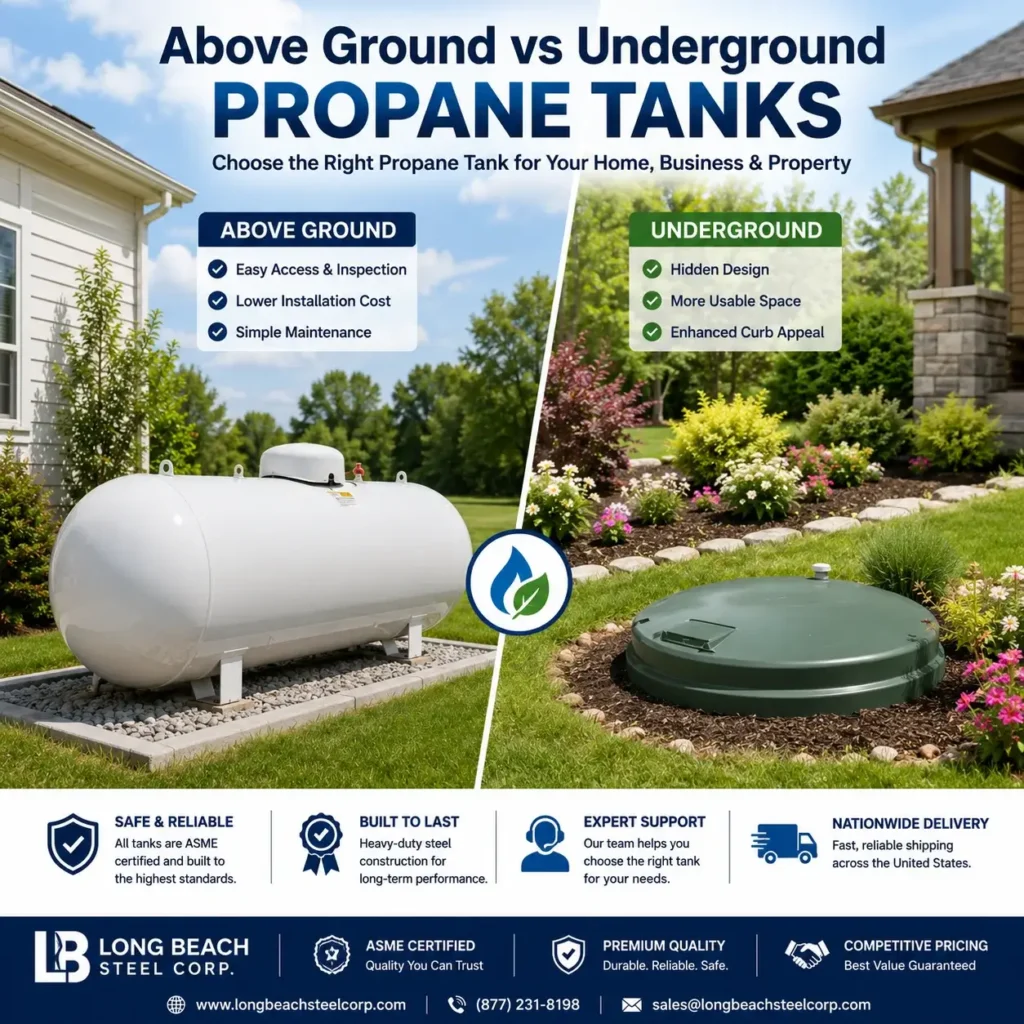
Above Ground vs Underground Propane Tanks
Choosing between above ground vs underground propane tanks is an important decision for homeowners, farms, businesses and industrial facilities that rely on propane storage. Both installation options can provide reliable propane storage, but they have different considerations relating to appearance, accessibility, installation, maintenance, property layout and cost.
The right propane tank depends on how much fuel you need, where the tank can be installed and how you plan to use your property. Understanding the differences between above-ground and underground propane tanks can help you make a more informed purchasing decision.
What Is an Above Ground Propane Tank?
An above-ground propane tank is installed outdoors with the tank remaining visible above the surface. This is one of the most common configurations for residential, agricultural and commercial propane storage.
Above-ground tanks are available in a variety of capacities. Smaller properties may use tanks such as a 120 gallon ASME propane tank or 250 gallon ASME propane tank, while larger homes, farms and commercial properties may require 500 gallon or 1,000 gallon tanks.
Because the tank remains visible, the installation location should be carefully planned. The tank needs appropriate separation from buildings, property boundaries, ignition sources and other potential hazards according to applicable requirements.
Advantages of Above Ground Propane Tanks
Easy Visual Access
One of the main advantages of an above-ground propane tank is accessibility. The tank can generally be viewed without excavation, making it easier to identify visible corrosion, damage or other conditions that may require professional attention.
Simpler Site Access
Above-ground tanks can provide straightforward access for authorized deliveries, inspections and maintenance when the installation has been properly planned.
Lower Installation Complexity
Compared with underground installations, above-ground tanks generally do not require excavation or backfilling around the tank. This can simplify site preparation, although the installation still needs to meet applicable requirements.
Wide Range of Capacities
Above-ground propane tanks are available in many sizes. For larger requirements, Long Beach Steel Corp offers options such as a 500 gallon ASME propane tank and 1000 gallon ASME propane tank.
Disadvantages of Above Ground Propane Tanks
The primary disadvantage is visibility. Some property owners prefer not to have a large propane tank in view, particularly in landscaped residential areas.
The tank also occupies outdoor space that could otherwise be used for landscaping, recreation or other purposes. Its location must be carefully selected to provide appropriate clearances and protection from potential hazards.
Weather exposure is another consideration. Above-ground tanks are exposed to the surrounding environment, so appropriate maintenance and inspection are important.
What Is an Underground Propane Tank?
An underground propane tank is installed below the ground surface, leaving little or none of the main tank body visible. This configuration can be attractive for properties where maintaining the appearance of the landscape is important.
Underground propane tanks can provide substantial storage capacity while minimizing the visible presence of propane equipment. However, they require additional planning because excavation, soil conditions, corrosion protection, drainage and future access must be considered.
Advantages of Underground Propane Tanks
Reduced Visual Impact
The most obvious advantage is appearance. Because the tank is buried, the property can retain a more open and landscaped appearance.
Preserves Above-Ground Space
An underground installation can allow the surface area above the tank to remain visually integrated with the surrounding property, subject to applicable restrictions regarding what can be placed over or near the installation.
Protection From Some Environmental Exposure
The underground environment can reduce direct exposure of the tank body to weather conditions. However, buried tanks require appropriate corrosion protection and professional inspection and maintenance.
Disadvantages of Underground Propane Tanks
Underground installation is more involved than simply placing a tank below the surface. Excavation, soil conditions, drainage, corrosion protection and access need to be considered before installation.
Maintenance and inspection can also be more complicated because much of the tank is not visible. Any work involving the buried tank or associated components may require additional site preparation.
It is also important to understand that not every propane tank is suitable for underground installation. The specific tank must be designed and approved for the intended service and installation configuration.
Above Ground vs Underground Propane Tanks: Cost
Cost should be considered across the entire project rather than simply comparing the purchase price of two tanks.
An above-ground installation may require less site preparation because excavation is not normally necessary. An underground installation can involve excavation, specialized corrosion protection, backfilling and additional site work.
However, the total cost depends on the tank capacity, property conditions, installation requirements, local regulations, labor and other project-specific factors.
For this reason, buyers should obtain a complete installation assessment rather than choosing solely on the initial tank price.
Which Propane Tank Is Best for Your Property?
There is no universal answer. The best option depends on your property’s layout, fuel consumption, available space, appearance preferences and installation requirements.
Choose Above Ground When:
- You have sufficient outdoor space.
- Easy visual access is important.
- You want a relatively straightforward installation.
- The visible appearance of the tank is acceptable.
- Delivery and maintenance access are priorities.
Consider Underground When:
- Reducing the visual impact of the tank is important.
- Your property is suitable for excavation.
- You want to preserve the visual appearance of landscaped areas.
- The appropriate underground-rated tank and protective systems are available.
- You are prepared for the additional installation planning involved.
Consider Propane Tank Size
The installation method is only one part of the decision. You also need to choose an appropriate propane storage capacity.
A smaller residential or light-use application may require a 120 or 250 gallon tank. Larger properties may require 500 or 1,000 gallon storage, while commercial and industrial facilities can need significantly larger tanks.
For larger projects, Long Beach Steel Corp also offers a 2000 gallon ASME propane tank and larger LPG storage solutions.
Our Propane Tank Sizes: A Complete Guide for Buyers provides additional information about choosing an appropriate tank capacity.
Safety and Installation Requirements
Regardless of whether you choose an above-ground or underground propane tank, installation should be handled according to applicable codes and by appropriately qualified professionals.
Factors such as separation distances, tank location, piping, valves, protection from vehicle impact, access and emergency considerations must be evaluated for the specific installation.
For detailed requirements relating to liquefied petroleum gas installations, consult the NFPA 58 Liquefied Petroleum Gas Code.
Propane users should also review the Propane Education & Research Council safety resources for general propane safety information.
For additional information regarding underground propane systems and consumer considerations, consult your qualified propane supplier and local authority having jurisdiction before installation.
Maintenance Considerations
Both above-ground and underground propane tanks require appropriate inspection and maintenance. Above-ground tanks allow easier visual observation of the tank body, while underground installations require particular attention to corrosion protection and components associated with buried service.
Do not attempt to modify, repair or alter pressure-containing equipment yourself. Qualified professionals should perform required inspections, repairs and servicing.
Above Ground vs Underground Propane Tanks: Final Considerations
When comparing above ground vs underground propane tanks, consider more than appearance. The best solution depends on your fuel requirements, property layout, installation conditions, maintenance preferences and budget.
Above-ground tanks can offer straightforward access and simpler site preparation, while underground tanks can reduce visual impact and preserve the appearance of a property. Both options require proper planning and compliance with applicable installation requirements.
Long Beach Steel Corp offers propane storage tanks in a range of capacities and conditions for residential, agricultural, commercial and industrial applications. Browse our propane tanks for sale to explore available options, compare capacities and contact us for current specifications, pricing and availability.