
Propane Tank Buying Guides
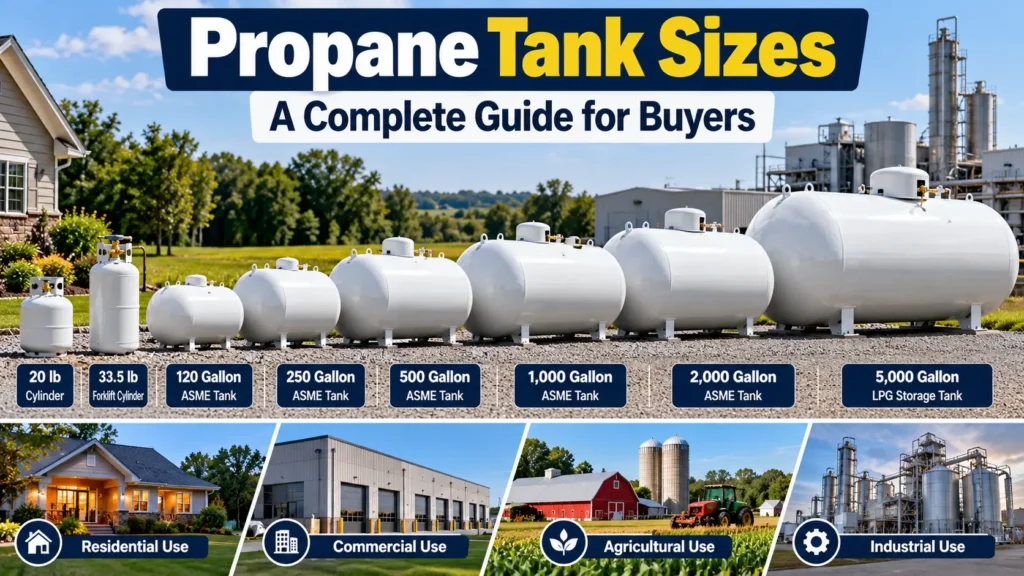
Propane Tank Sizes A Complete Guide for Buyers
Oct
Propane Tank Sizes: A Complete Guide for Buyers
Choosing the right propane tank sizes for your project starts with understanding how much fuel you expect to use, how often you can receive deliveries and what storage equipment your property can accommodate. A small portable cylinder serves a very different purpose from a stationary tank supplying several appliances or a large LPG vessel supporting an industrial operation. Comparing capacities before purchasing can help you avoid selecting equipment that does not meet your requirements.
Long Beach Steel Corp offers propane and LPG storage equipment in a variety of capacities and conditions. This guide explains how propane tank sizes are measured, how common capacities differ, what information buyers should gather before ordering and how to compare options for residential, agricultural, commercial and industrial applications.
What Do Propane Tank Sizes Actually Mean?
Propane containers are commonly identified by weight or volume. Portable cylinders are often marketed by their nominal propane weight, such as a 20 lb cylinder, while stationary tanks are commonly described by their nominal capacity in gallons.
These measurements describe different things. The 20 lb designation refers to the propane weight associated with the cylinder, whereas a 500 gallon tank designation refers to nominal volumetric capacity. It is therefore not appropriate to compare the numbers directly as if they represented the same measurement.
Another important distinction is the difference between nominal tank capacity and the amount of liquid propane that can safely be loaded. Propane expands as its temperature changes, so stationary storage vessels must be filled according to applicable requirements and the tank’s specifications. A tank’s advertised gallon capacity should not be interpreted as permission to fill it completely with liquid propane.
When comparing products, ask the supplier to clarify the stated capacity, the applicable filling requirements and the documentation available for the specific vessel. This is especially important when buying used or refurbished equipment.
Propane Tank Sizes Comparison Chart
The following table summarizes common capacities that buyers may encounter when researching propane storage equipment. Applications are illustrative rather than guarantees of suitability; actual selection depends on fuel demand, tank specifications and installation requirements.
| Nominal capacity | Equipment category | What buyers should evaluate |
|---|---|---|
| 20 lb | Portable cylinder | Appliance compatibility and operating time |
| 33.5 lb | Forklift cylinder | Forklift compatibility and cylinder configuration |
| 120 gallons | Stationary ASME tank | Smaller fixed-storage requirements |
| 250 gallons | Stationary ASME tank | Moderate fuel demand and delivery frequency |
| 500 gallons | Stationary ASME tank | Higher consumption and available installation space |
| 1,000 gallons | Stationary ASME tank | Greater storage needs and site access |
| 2,000 gallons | Large stationary tank | Commercial or industrial project requirements |
| 5,000 gallons | Large-capacity LPG tank | Bulk storage planning and delivery logistics |
| 10,000 gallons and above | Large-capacity LPG equipment | Substantial storage demand and project design |
This chart is a starting point for comparing equipment, not a sizing calculation. The appropriate capacity should be established from actual consumption, delivery arrangements and the requirements of the proposed installation.
Portable Propane Cylinders: 20 lb and 33.5 lb
Portable propane cylinders are designed for specific applications where fuel storage needs to remain relatively compact and the container must work with compatible equipment. Their size is generally chosen according to the equipment’s requirements, operating duration and cylinder configuration.
20 lb Propane Cylinder
A 20 lb propane cylinder is an option for compatible portable equipment, including certain outdoor cooking and recreational appliances. The actual duration of use depends on the connected appliance’s fuel consumption and how frequently it operates.
For example, an appliance running for several hours each day will generally consume fuel differently from equipment used occasionally. Buyers should check the appliance manufacturer’s requirements and estimate usage before deciding how many cylinders or refills they may need.
33.5 lb Forklift Propane Cylinder
A 33.5 lb forklift propane cylinder is intended for compatible propane-powered forklifts and material-handling equipment. Businesses operating warehouses, distribution facilities and manufacturing sites should verify the cylinder specifications required by their equipment manufacturer.
Forklift cylinders should not be treated as interchangeable with ordinary portable cylinders. The mounting arrangement, connection, valve configuration and intended service must all match the equipment’s requirements.
120 Gallon and 250 Gallon Stationary Propane Tanks
Stationary propane tanks are useful when fuel needs to be stored at a fixed location. Smaller stationary capacities may suit applications that require more storage than a portable cylinder but do not justify a larger vessel.
120 Gallon ASME Propane Tank
The 120 gallon ASME propane tank provides a smaller stationary storage option to investigate for suitable applications. Its suitability depends on the appliances being supplied, their combined fuel consumption, seasonal usage and the availability of deliveries.
A smaller tank may require more frequent replenishment if demand is high. Buyers should therefore compare the practical delivery schedule as well as the nominal capacity before choosing this size.
250 Gallon ASME Propane Tank
A 250 gallon ASME propane tank offers more nominal storage capacity than a 120 gallon model. It may be worth considering where the smaller tank would not provide the desired storage interval, provided the site can accommodate the equipment and its installation requirements.
When comparing these two capacities, consider fuel consumption, delivery access and available space together. A tank should not be selected solely because it fits into a convenient corner of a property.
500 Gallon and 1,000 Gallon Propane Tanks
These capacities are worth comparing when a project requires more stationary storage than smaller tanks provide. They may be relevant to larger homes, farms, commercial facilities and other applications, depending on the amount of propane consumed.
500 Gallon ASME Propane Tank
A 500 gallon ASME propane tank can be considered for applications with higher fuel requirements. Its greater nominal capacity may provide more flexibility between deliveries than a smaller tank, although actual performance depends on consumption and supplier arrangements.
Before choosing a 500 gallon tank, review the proposed installation area, required clearances, access for delivery vehicles and expected peak fuel demand. These practical factors are just as important as the tank’s advertised size.
1,000 Gallon ASME Propane Tank
A 1000 gallon ASME propane tank provides a larger storage option for applications with substantial propane requirements. Buyers should consider the equipment it will supply, expected operating hours, seasonal consumption and the logistics of replenishing the tank.
As capacity increases, transportation, unloading, site preparation and installation planning become increasingly important. Confirm the tank’s specifications and intended service before purchasing.
2,000 Gallon and 5,000 Gallon LPG Storage
Large stationary storage vessels can be considered when commercial, agricultural or industrial operations require substantially more propane or LPG than smaller tanks provide. At this level, tank selection should be based on an overall storage plan rather than on gallon capacity alone.
2,000 Gallon ASME Propane Tank
The 2000 gallon ASME propane tank is an option for buyers evaluating larger stationary storage equipment. Before selecting this capacity, determine the expected fuel demand and verify that the proposed site can accommodate the vessel and its associated equipment.
Commercial and industrial buyers should also consider the complete fuel system, including compatible piping, regulators, valves and other components specified by qualified professionals.
5,000 Gallon LPG Storage Tank
A 5000 gallon LPG storage tank can be considered for projects with bulk storage requirements. Buyers should confirm the actual vessel specifications, intended service, condition and available documentation rather than assuming that all tanks of the same nominal capacity are equivalent.
Large-capacity installations may require careful coordination of site preparation, transportation, unloading, support arrangements, access and regulatory requirements. Obtain project-specific guidance before committing to the equipment.
10,000 Gallons and Larger Storage Options
Some commercial and industrial operations require storage capacities of 10,000 gallons or more. These projects often involve substantial fuel demand, planned delivery arrangements and detailed site requirements.
Long Beach Steel Corp lists larger storage products, including a 10,000 gallon LPG tank and 18,000 gallon ASME skid tanks. The suitability of any particular product must be verified from its actual specifications and the needs of the project.
For these larger capacities, buyers should evaluate current and anticipated fuel demand, delivery frequency, available space and whether the proposed storage configuration suits the facility’s operations. A larger vessel is not automatically the most economical choice if the capacity exceeds the project’s requirements.
How to Calculate the Capacity Your Project Needs
A useful way to approach tank sizing is to work from fuel demand rather than starting with a preferred tank size. This process helps narrow the options before requesting a quotation.
1. List All Fuel-Using Equipment
Identify each appliance, machine or process that will use propane. A home may rely on heating, water heating and cooking equipment, while a commercial or industrial site may have several systems operating at different times.
2. Estimate Consumption
Use manufacturer specifications or seek professional assistance to estimate the fuel consumption of each item. Consider how long the equipment operates and whether multiple appliances may run simultaneously.
3. Account for Peak Demand
Average consumption may not represent the busiest operating period. Seasonal heating, production schedules or agricultural activity can create periods of higher demand. Include these variations when assessing storage requirements.
4. Set a Delivery Strategy
Discuss delivery frequency and supply availability with your propane supplier. The interval between deliveries can affect the capacity required to maintain an appropriate fuel reserve.
5. Confirm Site Suitability
Have a qualified professional evaluate the proposed installation location, equipment type, access, required clearances and applicable requirements. A capacity estimate by itself cannot determine whether a particular tank is suitable for a site.
For a broader decision-making framework, read our guide to choosing the right propane tank for your property.
Other Factors That Affect Tank Selection
Nominal capacity is only one part of a tank’s suitability. Two tanks of the same size may have different construction, installation requirements, intended service or condition.
Buyers should verify whether the equipment is intended for above-ground or underground installation. Not every tank is approved for burial, and underground installations require appropriate corrosion protection and site preparation. Our above-ground versus underground propane tanks guide covers the differences between these approaches.
Condition and documentation also matter. When considering used or refurbished equipment, ask for available identification, specifications, inspection records and information about the vessel’s history. A qualified professional should assess whether the individual tank is suitable for the intended service.
For LP-Gas storage and handling requirements, consult the NFPA 58 Liquefied Petroleum Gas Code. The Propane Education & Research Council safety resources provide general propane safety information. For applicable U.S. transportation and hazardous-material requirements, consult the Pipeline and Hazardous Materials Safety Administration. Confirm the requirements adopted by the authority responsible for your specific installation.
Delivery, Installation and Total Project Cost
The purchase price of a tank is only one component of the total project cost. Depending on the equipment and site, buyers may also need to account for transportation, unloading, site preparation, support arrangements, installation, compatible components and inspections.
Before ordering, ask the supplier whether freight is included, who is responsible for unloading, what documentation accompanies the vessel and whether any special delivery arrangements are required. Make sure the proposed installation site is ready to receive the equipment.
Future demand is another consideration. If a facility plans to add appliances, increase production or expand its operations, it may be worth evaluating anticipated fuel consumption before settling on a capacity. The objective is to select a tank that suits the actual project rather than automatically choosing the largest available option.
Propane Tank Sizes: A Practical Buying Checklist
Before making your final decision, confirm the following points:
- Expected propane consumption and peak demand.
- Required nominal storage capacity.
- Type of equipment being supplied.
- Available installation space and site access.
- Whether above-ground or approved underground storage is appropriate.
- Tank specifications, markings and intended service.
- Condition and available documentation.
- Delivery, unloading and installation arrangements.
- Applicable regulations and professional installation requirements.
- Current product availability, pricing and any additional project costs.
Compare Propane Tank Sizes at Long Beach Steel Corp
The best propane tank size depends on the relationship between fuel consumption, storage capacity, delivery schedules and installation conditions. Portable cylinders serve specific equipment requirements, smaller stationary tanks may suit moderate storage needs, and large-capacity LPG vessels can be considered for substantial commercial and industrial demand.
Long Beach Steel Corp offers propane and LPG storage equipment in a range of capacities and conditions. Browse our propane tanks for sale to compare available products, including 120 gallon, 250 gallon, 500 gallon, 1,000 gallon and 2,000 gallon ASME tanks, along with larger LPG storage options.
Contact Long Beach Steel Corp to confirm current availability, specifications, condition, pricing and delivery arrangements. Before purchasing or installing a tank, verify that the individual vessel is appropriate for your intended application and have qualified professionals assess the proposed storage system.

Pingback: How to Choose the Right Propane Tank for Your Property - Propane tanks for sale