
Propane Tank Buying Guides
The Complete Guide to Propane Storage Tanks
Oct
The Complete Guide to Propane Storage Tanks
Propane storage tanks are an important part of fuel storage systems used by residential properties, agricultural operations, commercial businesses and industrial facilities. Selecting appropriate storage equipment involves understanding how the tank will be used, what specifications are required, how the equipment will be installed and what documentation is available. For buyers, the goal is not simply to find a tank with enough capacity, but to identify equipment that matches the project’s operational and site requirements.
Long Beach Steel Corp supplies propane and LPG storage equipment in different capacities and conditions. This guide explains the main components of propane storage systems, the differences between common equipment types, the information buyers should review before purchasing and the considerations involved in planning a storage project.
Understanding Propane Storage Systems
Propane is a liquefied petroleum gas commonly used as a fuel for heating, cooking, power generation, agricultural processes and selected industrial applications. It is stored under pressure in containers designed for the intended service. When the system supplies an appliance or process, the fuel delivery equipment regulates and controls the supply according to the system’s design.
A propane storage system can include the storage vessel, valves, pressure regulators, piping, level-indication equipment and other compatible components. The exact configuration depends on the application, the tank design and the requirements of the installation.
The storage vessel is only one part of the overall system. Buyers should therefore consider the complete installation rather than treating tank capacity as the only purchasing criterion. Compatibility, site preparation, professional installation, inspection access and ongoing servicing can all affect whether a proposed solution is appropriate.
Common Types of Propane Storage Equipment
Propane storage equipment is available in several forms. Understanding their intended purposes helps buyers narrow down suitable products before comparing individual specifications.
Stationary ASME Propane Tanks
ASME propane tanks are commonly used for stationary storage at residential, agricultural, commercial and industrial locations. These vessels are designed and marked according to the applicable requirements for their intended service. Their suitability must be confirmed from the actual tank markings and documentation rather than assumed from appearance or capacity alone.
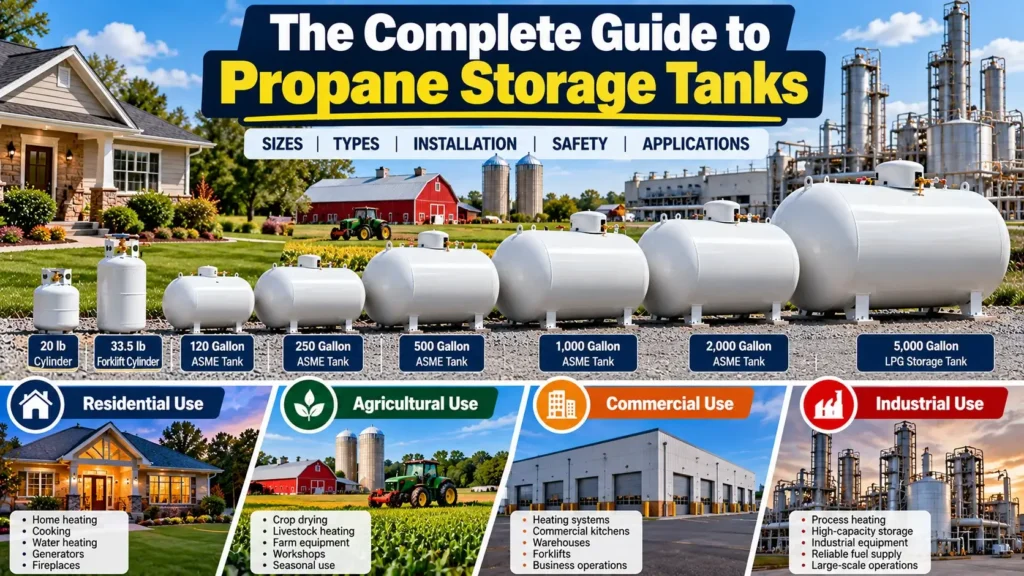
Stationary tanks are available in different sizes. For example, Long Beach Steel Corp offers a 120 gallon ASME propane tank, a 500 gallon ASME propane tank, and a 1000 gallon ASME propane tank. These products illustrate the range of capacities buyers may consider when planning stationary storage.
Portable DOT Propane Cylinders
DOT-specification propane cylinders are associated with portable applications and transportation under applicable U.S. Department of Transportation requirements. They are used with compatible equipment in settings such as outdoor cooking, recreation and certain commercial operations.
Smaller portable cylinders and forklift cylinders serve different equipment requirements. A 20 lb propane cylinder and a 33.5 lb forklift propane cylinder should not be treated as interchangeable simply because both store propane. Buyers need to verify the required cylinder type, connection, orientation and intended use.
For a more detailed explanation of these equipment categories, see our propane tanks and cylinders collection and review the product information for the specific item being considered.
Large-Capacity LPG Storage Vessels
Commercial and industrial projects may require larger vessels for bulk LPG storage. The appropriate equipment depends on expected consumption, supply arrangements, available space, operating conditions and the storage system’s design.
Large-capacity equipment should be evaluated individually. Nominal capacity alone does not establish the vessel’s design pressure, certification, suitability for a particular LPG service or permission to install it at a proposed location. Buyers should obtain the relevant specifications and documentation before making a purchasing decision.
How to Evaluate Storage Capacity
Tank capacity should be selected around the actual requirements of the application. A system that is too small may not provide the storage needed between deliveries, while an unnecessarily large tank can introduce additional purchase, transportation, installation and site-planning costs.
Begin by estimating fuel consumption over a representative operating period. Consider seasonal changes, peak demand, equipment usage and the expected frequency of deliveries. A business that operates continuously may have different requirements from a property that uses propane intermittently.
Also distinguish between a tank’s stated capacity and the amount of propane that can be stored under the applicable filling requirements. The nominal gallon rating should not be interpreted as permission to fill the container completely with liquid propane. Safe filling limits depend on the vessel and applicable requirements.
Once demand has been estimated, discuss the proposed capacity with a qualified propane supplier or system designer. Our Propane Tank Sizes: A Complete Guide for Buyers provides a separate resource for comparing common capacities and understanding the factors involved in sizing a storage system.
Above-Ground and Underground Storage
Some stationary propane tanks are installed above ground, while suitable vessels can be designed for underground installation. These approaches have different site, access and maintenance implications, so the decision should be made during project planning.
Above-Ground Installations
An above-ground tank remains visible and can provide more direct access for authorized visual checks and servicing. The site must still provide appropriate space, delivery access and protection against foreseeable hazards. Required separation distances and other installation conditions must be determined under the applicable rules.
Underground Installations
An underground tank can reduce the visual presence of storage equipment, but it requires a vessel specifically suitable for buried service. Soil conditions, drainage, corrosion protection, excavation, access points and future inspection requirements need to be addressed.
Not every above-ground tank is suitable for burial. Buyers should verify the manufacturer’s documentation and the tank’s approval for the intended installation before purchasing. Read our Above Ground vs Underground Propane Tanks guide for a more detailed comparison of the two installation approaches.
Applications Across Different Industries
Propane storage requirements vary according to the work performed at a site. Understanding the intended application helps buyers identify the type of equipment and supporting system that should be evaluated.
Residential Properties
Residential propane systems may supply compatible heating equipment, water heaters, cooking appliances and backup power systems. The required storage capacity depends on household demand, climate, appliance efficiency and delivery arrangements. A tank should be selected with the help of a qualified provider rather than by property size alone.
Agricultural Operations
Farms and agricultural businesses may use propane for approved heating, drying, processing and equipment applications. Demand can vary significantly throughout the year, particularly when operations are seasonal. Storage planning should account for peak usage and the accessibility of the installation site for deliveries.
Commercial Facilities
Restaurants, hospitality properties, workshops and other businesses may require propane for heating, cooking or operational equipment. Buyers should assess the consequences of running out of fuel, the space available for storage and how deliveries can be coordinated with normal business activity.
Industrial Facilities
Industrial applications can involve continuous or high-volume fuel demand. The storage vessel, fuel delivery arrangement, piping and other system components should be evaluated together. Engineering review may be needed to establish the appropriate capacity and installation design for the specific operation.
What to Check Before Purchasing a Propane Tank
Before purchasing storage equipment, request enough information to establish whether the specific vessel matches your requirements. The following checks can help organize the buying process.
1. Confirm the Product Specifications
Review the stated capacity, dimensions, weight, orientation, manufacturer and model where available. Confirm the intended service and any limitations relevant to the proposed application. Do not rely on a generic product title as a substitute for the tank’s actual specifications.
2. Verify Markings and Documentation
Ask for available nameplate information, certification details, inspection records and other supporting documentation relevant to the vessel. Requirements depend on the equipment type and jurisdiction. A seller’s description alone should not be treated as proof that a tank meets every requirement for a proposed installation.
3. Establish the Tank’s Condition
New, used and refurbished tanks can differ in condition, documentation and availability. For used or refurbished equipment, request details about its known history, visible condition and any inspection or repair records available. Have a qualified professional determine whether the vessel is suitable for the intended service.
4. Plan Delivery and Installation
Large tanks can require specialized transportation, unloading equipment and careful positioning. Before ordering, verify delivery arrangements, site access, unloading responsibilities and whether any preparation must be completed before the tank arrives.
5. Confirm the Applicable Requirements
Storage and installation requirements depend on the tank, its contents, the installation type and local rules. In the United States, the NFPA 58 Liquefied Petroleum Gas Code is an important reference for LP-Gas storage, handling, transportation and use. Applicable regulations and the requirements adopted by the relevant authority should be confirmed for the specific project.
Maintaining a Propane Storage System
Maintenance should follow the equipment manufacturer’s instructions and the requirements that apply to the installation. Owners should arrange appropriate inspections and servicing through qualified personnel, maintain access to required equipment and address reported defects promptly.
Maintenance planning should also consider the condition of visible components, valves, connections, protective coatings and any installed monitoring equipment. Underground tanks require particular attention to their specified corrosion-protection system and inspection arrangements because the vessel itself is not fully visible.
Never attempt to repair a pressure vessel, modify its components or investigate a suspected gas leak without appropriate training and authorization. If a leak or other immediate hazard is suspected, follow the site’s emergency procedures and contact the appropriate emergency service or qualified propane provider.
For additional safety information, the Propane Education & Research Council safety resources provide information for propane users. Transportation and other applicable federal requirements should also be checked where relevant through the Pipeline and Hazardous Materials Safety Administration.
Why Product Documentation Matters
Documentation helps buyers compare equipment accurately and gives installers information needed to assess suitability. It can also help distinguish between tanks that look similar but have different specifications, histories or intended uses.
When requesting a quotation, provide the desired capacity, intended application, installation type and location. Ask the supplier which specifications and records are available for the particular tank being offered. If a required detail has not been confirmed, obtain clarification before treating it as a product feature.
For projects involving used or refurbished equipment, documentation and condition checks deserve particular attention. The suitability of a vessel should be based on the individual tank and the proposed service, not on a general assumption about its age or appearance.
Explore Propane Storage Tanks from Long Beach Steel Corp
Choosing propane storage equipment is a project-specific decision. The right option depends on fuel demand, required capacity, tank type, site conditions, documentation, delivery logistics and applicable installation requirements. Reviewing these factors before purchasing can help buyers narrow their options and avoid selecting equipment that does not fit the intended application.
Long Beach Steel Corp offers propane and LPG storage products in a range of capacities and conditions. Explore our propane tanks for sale to review available equipment, compare relevant product details and identify options for your project.
Before placing an order, contact Long Beach Steel Corp to confirm current availability, specifications, condition, pricing and delivery arrangements. For any proposed installation, work with qualified professionals to verify that the selected vessel and complete storage system are suitable for the intended use and comply with applicable requirements.
